
FREE RESOURCE · PRINTABLE
The one-page trading plan.
Seven boxes to fill in before you trade again. Each one removes a decision you would otherwise make with a position open and money moving.
Updated 2026-09-04 · Educational content · No broker owns this site
Quick answer. A trading plan is a one-page document that fixes your instrument, timeframe, risk unit, entry and exit rules, and loss limits in advance. Fill it in before you trade, not during. Every box exists to remove one decision you would otherwise make while a position is open.
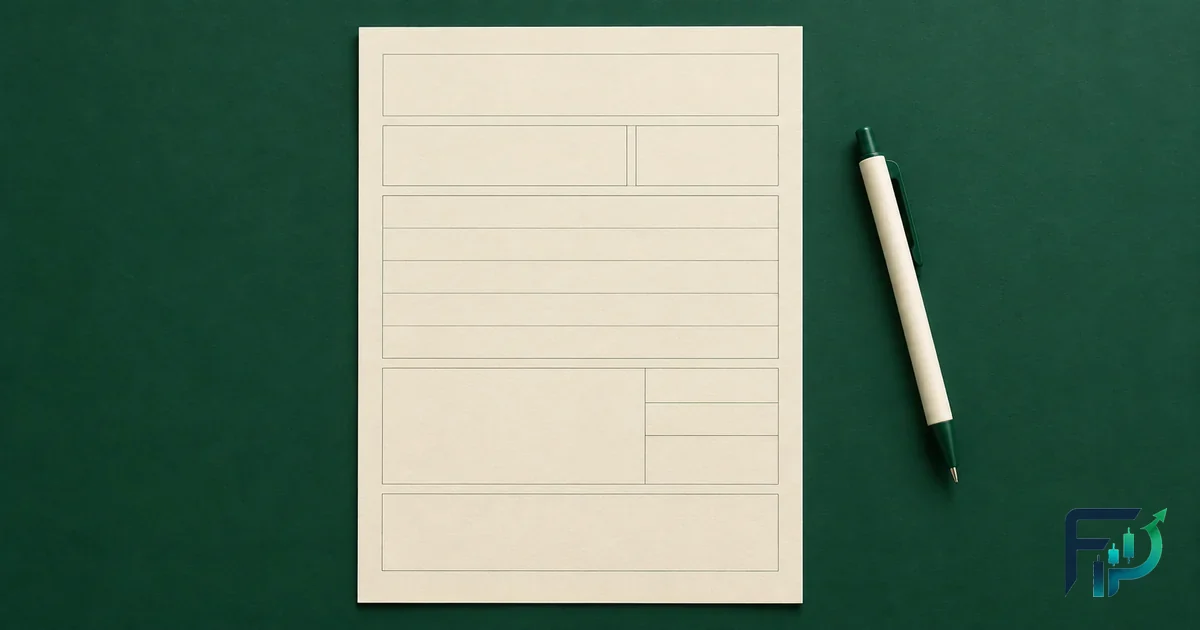
Why is a trading plan one page?
Any trade has four possible outcomes: right with a strong move, right but the move stalls, wrong with a stop and correct size, and wrong with no stop and no size limit. An account containing only the first three looks healthy. Every account problem lives in the fourth — and the fourth is not an analysis failure. It is a decision made while a position was open.
A written plan moves those decisions to a moment when nothing is at stake, and makes them checkable afterwards. That is the whole mechanism — and the reason the document has to stay short enough to read in thirty seconds, because otherwise it will not be in your head when it matters.
The template — fill this in
Write in it by hand or copy it into a note. Print this page and the navigation, banners and sign-up form disappear automatically, leaving the table and the rules.
| Box | What belongs here | Your answer |
|---|---|---|
| 1. Instrument | The one or two pairs you will trade — and one sentence each on why that pair can move. If you cannot write the sentence, remove the pair. | |
| 2. Timeframe & rhythm | The chart you enter on, and what that implies: how often you check, and whether you can be at the screen. A 5-minute entry needs supervision an H4 entry does not. | |
| 3. Risk unit (1R) | The percentage of the account you risk per trade, and the money figure that equals today. Both, in writing. | |
| 4. Entry rule | The conditions that must all be true before you click. Written so a stranger could check it: "if X and Y, then buy" — never "when it looks good". | |
| 5. Exit rules | Two lines. Where the stop goes and what invalidates the idea. And what closes a winner — a fixed multiple of R, a level, or a signal. Pick one and keep it. | |
| 6. Loss limits | Losses in a row that end the day. Percentage that ends the month. Fill both in now; you will not set them fairly later. | |
| 7. Review cadence | When you read the log back, and what you are looking for — the mistake that appears twice. Name the day and the time. |
Standing rules
- I place the stop in the same action as the entry — never afterwards.
- I do not trade an instrument I cannot explain in one sentence.
- If the stop has to be tight, I cut the position size. I do not move the stop to fit a size I already picked.
- Losses in a row that end my day: ___. When I hit it I close the platform, and that is not negotiable in the moment.
- I do not place a trade to win back an earlier loss.
- I log every trade when I click, not at the weekend — and I log the days I stand aside.
- I do not trade while ill, exhausted, angry, or otherwise not sharp.
Why is each box on the page?
This is the part most templates leave out, and it is what separates a form you fill in once from a document you use.
- Instrument — the sentence requirement is a filter, not a formality. Every extra instrument multiplies the variables you have to model, and exotics add spread, slippage and single-headline sensitivity to a problem you have not solved yet.
- Timeframe & rhythm — the timeframe silently sets everything else: where the stop belongs, how long a trade lives, whether you need to be at the desk. Skip this box and you end up watching a 5-minute chart for a trade you entered on H4, which is how good positions get closed early.
- Risk unit — the box that decides whether you are still trading in six months. Size is derived from the risk unit, never chosen first: size = risk amount ÷ (stop distance in pips × value per pip per lot). At 1% it takes a hundred consecutive losses to end an account. At 10% it takes ten.
- Entry rule — written as a testable condition, it is what stops "the chart looks good" from becoming an order. A rule that cannot be failed cannot be followed. Beginners typically accept six or seven opportunities out of ten; a written rule exists to make most of them a clear no.
- Exit rules — the stop belongs where the idea is proven wrong, on the timeframe you entered on: not an arbitrary distance, not an unrelated historical level. Deciding the exit in advance beats deciding it with a position open, because at that moment you are not the person who wrote the plan.
- Loss limits — losses arrive in clusters, and the third one is where judgement goes. Three losses at 1% is 3% of the account: recoverable, and cheap to walk away from. Trading through it is what turns 3% into 30%. The monthly limit does the same job one level up.
- Review cadence — without it the plan never learns. The question is not "did I win". It is: where was the better exit, how far from it did I close, which action of mine caused the gap. Look for the error that appears twice — that one is a habit, not an accident.
What is deliberately not on this template?
There is no profit target box, and that absence is the most considered thing on the page.
A monetary goal — "$500 this month" — is a quota the market never agreed to supply. You control your risk and your execution, not the outcome, so the pressure of a target lands on the only two levers you can pull: how often you trade, and how big. Those are the levers that damage accounts. The failure mode is documented and it is not subtle: a trader with a weekly dollar goal traded a full session with flu because the number was still short, and later called his own judgement that day ridiculous.
Replace it with process goals you can score honestly at the end of a week: risk stayed inside 1R on every trade, no trade outside the entry rule, the daily loss limit respected, every trade logged. Money is the byproduct.
How much is 1R on your account?
Box 3 needs a money figure, not just a percentage. This is pure arithmetic — it forecasts nothing, and it says nothing about how likely a losing run is. It only shows what one would cost.
| Account size | 1R at 0.5% | 1R at 1% | 1R at 2% | Daily stop at 1% (3 losses) |
|---|---|---|---|---|
| $500 | $2.50 | $5 | $10 | $15 |
| $1,000 | $5 | $10 | $20 | $30 |
| $2,000 | $10 | $20 | $40 | $60 |
| $5,000 | $25 | $50 | $100 | $150 |
| $10,000 | $50 | $100 | $200 | $300 |
If the 1% figure for your account looks too small to be worth the effort, that reaction is worth writing in the margin. It is the exact feeling that later becomes a 5% position, and it is a statement about the account size, not about the rule.
How does the plan stay alive?
Two habits carry most of the weight. Write the log entry at the moment you click, because a memory reconstructed on Saturday has already flattered you. And log the days you stand aside — those are most days, and a log that skips them throws away most of your data.
Before you use it
Fill the plan in once, print it, and keep it where you trade. Then run the pre-trade checklist before each order: the plan sets the rules, the checklist enforces them one trade at a time. Neither predicts a market. They only make sure that when you are wrong, you are wrong small.
Frequently asked questions
How long should a trading plan be?
One page. A plan you cannot read in thirty seconds is a plan you will not read at all, and it will not be in your head at the moment it matters. Depth belongs in your journal and your review notes, not in the document you keep beside the platform.
Should a trading plan include a profit target?
Not a monetary one, and not while you are learning. A money figure is a quota the market never agreed to fill, and the pressure lands on the two things that actually damage accounts: trade frequency and position size. Set process targets instead — risk stayed within 1R, every trade logged, rules unbroken.
What is 1R?
One R is your risk unit: the single fixed amount you accept to lose if a trade hits its stop. Most beginner guidance sits at 0.5% to 1% of the account. You fix it once, write it in box 3, and every position size is then derived from it rather than chosen first.
Can I change my plan?
Yes — at your scheduled review, in writing, with a reason. Never with a position open. A plan amended mid-trade is not a plan; it is the trade talking. That is why the review cadence is a box on the page rather than an afterthought.
Do I need a plan on a demo account?
That is exactly what a demo is for. The plan is a set of habits, and habits have to be trained where the mistakes are cheap. "I will be careful once the account is bigger" is the reasoning the whole document exists to prevent.
Sources
- FirstPip knowledge base — Foundational trading rules (risk/foundational-trading-rules)
- FirstPip knowledge base — Risk per trade (risk/risk-per-trade)
- FirstPip knowledge base — The trading blueprint (strategy/trading-system-blueprint)
- FirstPip knowledge base — The written trading journal and post-trade review (strategy/trading-journal-and-review)
- FirstPip knowledge base — Trading session routine (strategy/trading-session-routine)
- FirstPip knowledge base — Profit targets and trading in an impaired state (psychology/profit-goals-and-impaired-state)
- FirstPip knowledge base — Execution errors (psychology/execution-errors)
- Figures on this page are arithmetic or rules of practice drawn from the sources above. They are not performance claims, and no part of this page predicts a result.