
News analysis ·
Digital euro by 2029? What it means for EUR/USD
The ECB's Cipollone set out a 2027 pilot and a possible 2029 digital euro launch. We explain why a new form of money is not a new exchange rate.
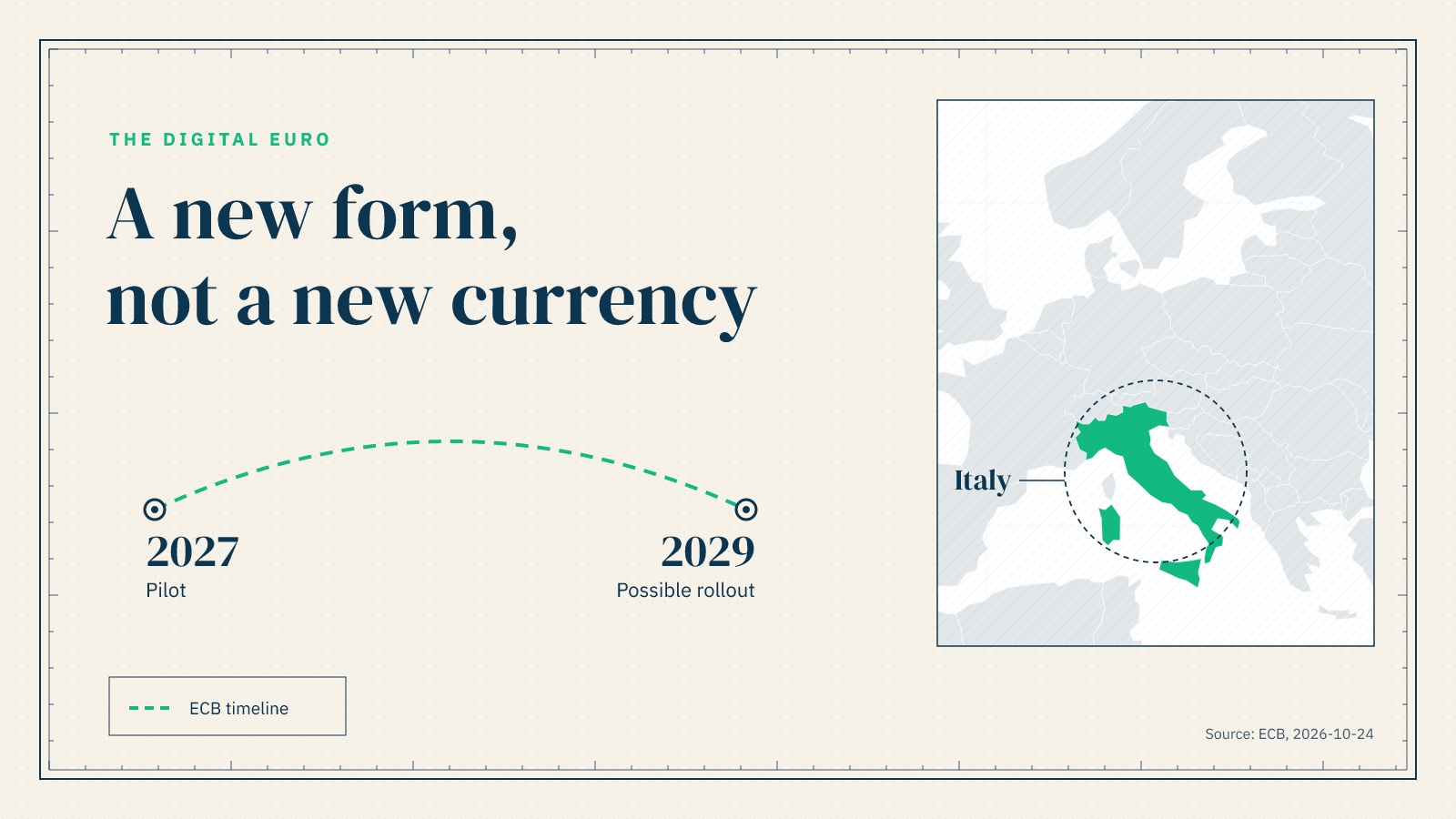
Piero Cipollone, a policymaker at the European Central Bank, laid out the path to a digital euro in an interview with Milano Finanza that the ECB published on 2026-10-24. A pilot is planned for 2027, and a launch could come as early as 2029 if EU lawmakers agree the rules in time. This article looks at what was said, and at a question beginners often ask: does a digital euro change the euro on your trading screen?
What the ECB official said
Cipollone's starting point is simple. Today, the only central bank money ordinary people can hold is cash. Cash does not work online. The digital euro is meant to fill that gap, so that public money can be used for online, in-store and person-to-person payments.
He gave an example from Italy, where online payments made up 6% of all payments in 2019 and 24% in 2024. According to the ECB interview, two thirds of online card payments run through card schemes based outside Europe, which Cipollone framed as a lack of direct control over key infrastructure.
He summed up why the ECB treats payments as part of its job: "If the payment system stops working, the economy stops working."
The timeline and the design choices
First comes a pilot in 2027, using real transactions by staff of the ECB and the national central banks. 36 market operators, seven of them Italian, already help with preparations. Then the law: Cipollone said the ECB Governing Council can only decide on issuance after the negotiations in Brussels end. If the regulation is approved this year, a rollout could start in 2029.
Some design points matter for how the money behaves:
- There will be a cap on how much digital euro a person can hold, but no cap on spending. A bigger payment can draw the rest from a linked bank account.
- The ECB will not set a yearly amount to issue. As with cash, use will follow demand from people and firms.
- Offline payments between two nearby devices will be possible, with details kept between payer and payee.
- Banks can add it to their own apps, and the ECB will not open accounts for individuals.
Cipollone said the holding cap protects financial stability, especially in a crisis. He described the digital euro as a payment instrument, not a tool for the ECB to steer how people spend, and said cash, the digital euro and bank payments are meant to exist side by side.
Why currencies care: a new form, not a new currency
Here is the key point for a forex beginner. A digital euro is still the euro. It is worth exactly the same as a euro banknote or a euro in your bank account. It is a new way to hold and pay with the same money, not a second currency with its own price.
That matters when you read a pair like EUR/USD. The euro is the base currency, the first one in the pair. The US dollar is the quote currency. The exchange rate tells you how many dollars one euro buys. A pip is the smallest standard step in that price. None of this changes when the euro gains a digital form, because the screen prices the currency, not the wallet it sits in.
What does move the euro, in principle, is the value of holding it. That comes mostly from interest rates set by the ECB Governing Council and from inflation. If markets expect higher euro rates than dollar rates, holding euros pays more, and demand can rise. If inflation erodes what a euro buys, demand can fall. Payments projects shape how Europeans pay. Rate decisions shape what the euro earns.
This is why interviews like this one are usually not big market events. There is no rate decision in it and no new inflation figure. It is useful background on how the ECB thinks about its role, not a signal about where EUR/USD goes next.
Beginner risk check
Headlines about the euro can still pull new traders into rushed decisions. Before you act on any central bank story, run through these points:
- Volatility: the euro can move sharply on ECB rate decisions and inflation releases. A payments interview rarely does, so check what kind of news you are reading before you assume a move.
- Spreads: around big scheduled events, the gap between bid and ask prices can widen, so a trade costs more to open and close.
- Leverage: borrowed exposure magnifies every pip in both directions. On a busy news day, a small move against you can become a large loss on a small account. Leveraged forex trading can lose money quickly, and you can lose more than you expected.
What comes next
Two dates stand out. A pilot with real transactions by ECB and national central bank staff is planned for 2027. A rollout could start as early as 2029, but only if EU lawmakers approve the regulation this year. The Governing Council can decide on issuance only after the Brussels negotiations end. Cipollone also pointed to Pontes, live since 21 September 2026, which settles DLT-platform transactions in central bank money. For beginners, the lesson is that rate decisions drive the euro's price, while payments news is background.
Sources
- ECB, 24 Oct 2026
This article was produced by AI from the cited sources and published automatically after automated checks (figures traced to sources, no copied phrasing); it was not edited by a person. It is beginner education, not trading advice.