
News analysis ·
ECB lending survey: are rate hikes biting the euro area?
The ECB's October bank lending survey shows tighter credit and weaker loan demand. We explain why this matters for the euro and for beginners.
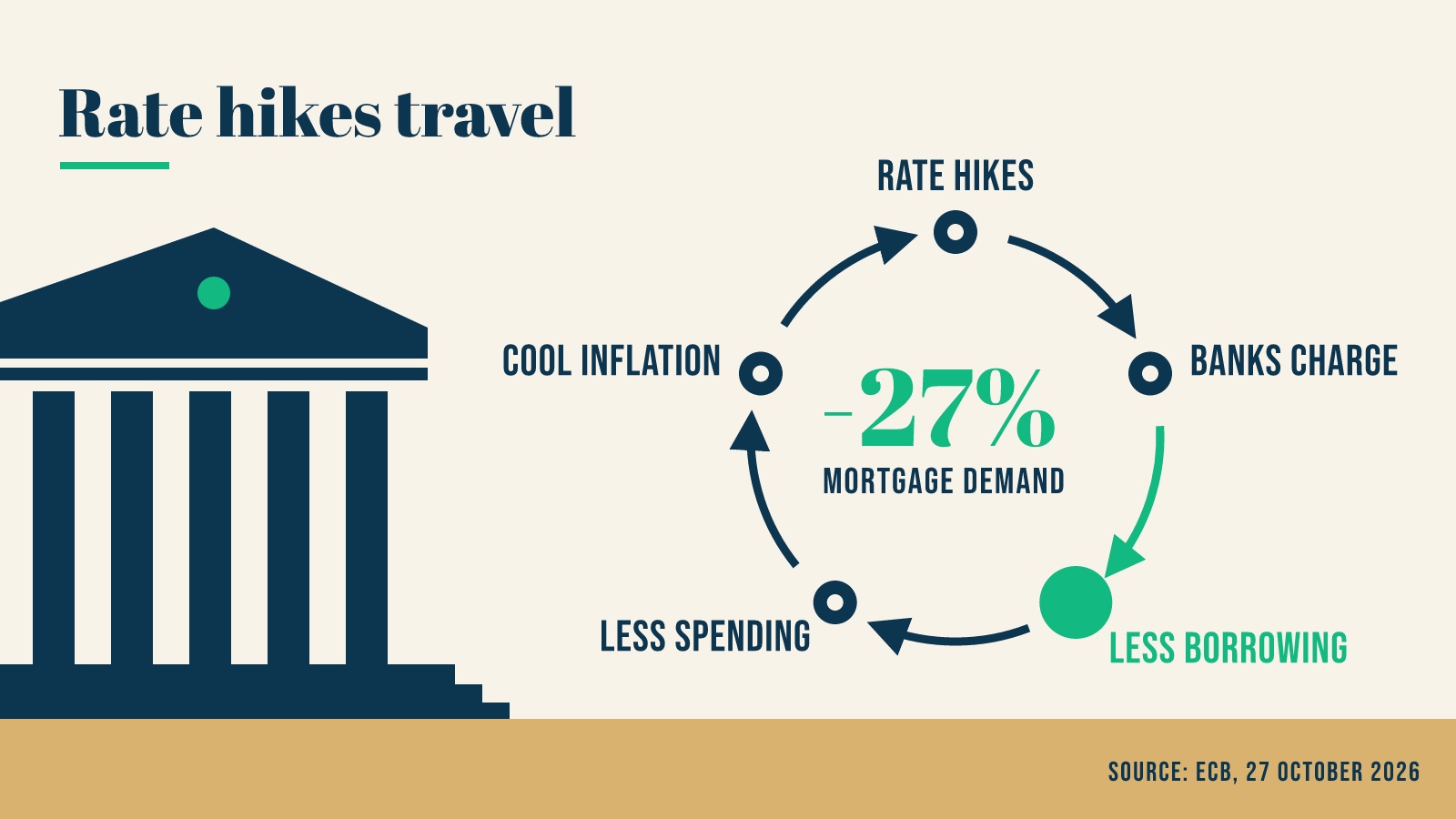
The ECB has released its October 2026 bank lending survey, and it shows euro area banks lending more cautiously while households and firms borrow less. According to the ECB, higher interest rates are the main reason. This article looks at what the survey found, why a central bank cares so much about bank loans, and how a report like this connects to the euro.
What the ECB survey found
The bank lending survey is a regular check-up. The ECB asks banks how their lending rules changed in the last quarter and what they expect next. This round ran from 21 September to 6 October 2026. It covered 159 banks, and the response rate was 100%.
The picture is one of tighter credit. A net 9% of banks made their rules for business loans stricter in the third quarter. That was more than the 5% they had predicted in the previous round. Rules for home loans were unchanged at a net 0%, while consumer credit tightened by a net 14%. The terms written into actual loan contracts also got tougher in every category, mostly because of higher interest rates.
Demand for credit weakened too. Business loan demand fell to a net -6%, after a small rise of 3% in the second quarter. Mortgage demand dropped more sharply, to a net -27%, compared with -15% the quarter before. Banks named the level of interest rates as the main brake on borrowing. They also cited higher risk perceptions, a lower appetite for risk, geopolitical uncertainty and energy developments.
Why a central bank watches bank loans
When a central bank raises its policy rate, nothing happens to ordinary people on that day. The effect has to travel. Banks pay more to fund themselves, so they charge more for loans. Some people and firms then decide not to borrow. Less borrowing means less spending, and less spending can cool inflation over time. Economists call this journey the transmission of monetary policy.
The bank lending survey is one of the clearest windows onto that journey. The ECB said the weaker demand for home loans fits with rate changes reaching borrowers as intended. In its words: "The contribution from interest rates is consistent with policy rate changes being transmitted smoothly to financing conditions." The ECB also noted that the fall in mortgage demand, while large, is still far below the low point of the previous cycle of rate rises.
Banks also said that the ECB shrinking its monetary policy asset portfolio had a mildly negative effect on their market financing and liquidity over the past 12 months. In addition, their access to retail funding, meaning customer deposits and similar money, worsened by the most since the series began in 2011.
Why currencies care
A currency is quoted in pairs. In EUR/USD, the euro is the base currency and the US dollar is the quote currency. The price tells you how many dollars one euro buys. When that price changes by the smallest standard step, traders call it a pip.
Interest rates are one of the big forces behind such a price. In principle, if investors expect euro area rates to stay high, holding euros can look more attractive, which can support the euro. If they expect rates to fall, the opposite pressure can appear. A survey like this does not set rates. But it feeds the debate about what the ECB may do next. Signs that hikes are working can be read in two ways: proof that policy is effective, or a hint that the economy is slowing enough for the ECB to pause. Different traders weigh these readings differently, so the market reaction is never certain.
The key lesson for a beginner is that the euro reacts to expectations, not to a single number. A report only moves a pair if it changes what people think the central bank will do.
Beginner risk check
Central bank reports and data releases can bring sudden moves. Before trading around them, keep these points in mind.
- Volatility: a pair can jump in both directions within minutes, and a stop loss may be filled at a worse price than you set.
- Spreads: the gap between the bid and ask price often widens around releases, so a trade costs more to open and close.
- Leverage: borrowed exposure magnifies every pip, so a small move against you can take a large share of your account.
Leveraged forex trading can lose money quickly, and you can lose your money on a fast news day. This article explains a report. It is not a trade idea.
What banks expect next
Looking ahead to the fourth quarter of 2026, banks told the ECB they expect to tighten rules further for firms and to tighten significantly for home loans and consumer credit. They forecast demand for housing loans to fall by -36% and consumer credit demand by -14%, with business demand roughly flat at -1%.
These are expectations, not outcomes. The next survey will show whether banks were right. Until then, the report is one more piece of evidence the ECB and the market will weigh when they think about the path of euro area interest rates.
Sources
- ECB, 27 Oct 2026
This article was produced by AI from the cited sources and published automatically after automated checks (figures traced to sources, no copied phrasing); it was not edited by a person. It is beginner education, not trading advice.