
News analysis ·
ECB's Elderson on bank rules: is it a euro signal?
ECB's Frank Elderson spoke about bank supervision, not interest rates. Here is how forex beginners can tell a rate signal from a bank-rules story.
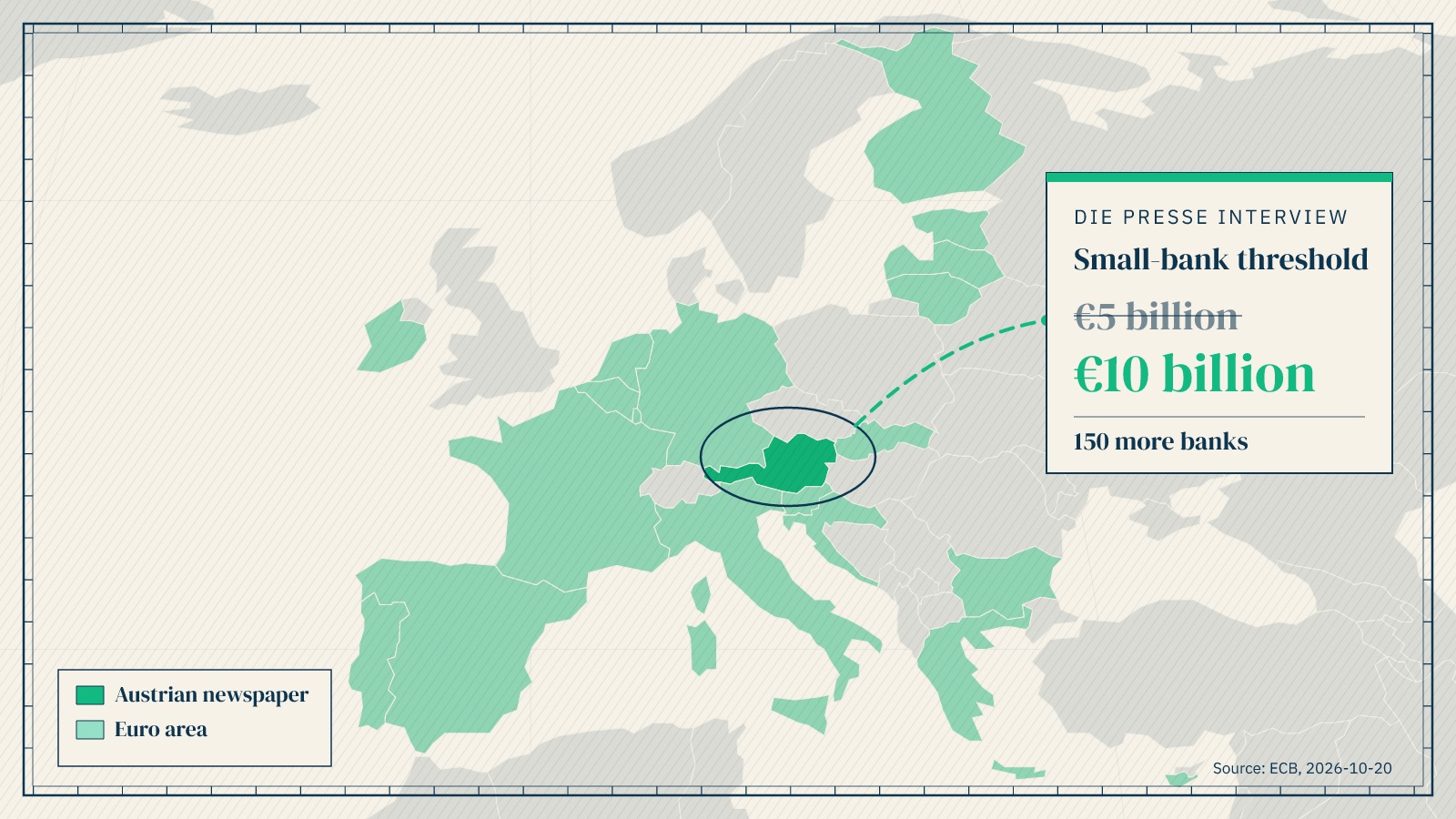
The ECB published an interview that Frank Elderson gave to the Austrian newspaper Die Presse, dated 2026-10-20. He talked about bank rules, competition between banks, AI and private credit, and said nothing about interest rates. This article explains what he said and, more usefully for beginners, how to tell whether an ECB voice is talking about the price of money or about the safety of banks.
What Elderson told Die Presse
Elderson spoke as a bank supervisor. A supervisor is the official who checks that banks hold enough capital (their own money as a loss buffer) and enough liquidity (cash or assets they can sell fast). According to the ECB text, he said euro area banks are well capitalised, hold plenty of liquidity and are on average more profitable than they have been in many years.
He defended the rules brought in after the 2008 financial crisis. In his view, that crisis cost households, firms and taxpayers far more than the rules now cost banks. He said the ECB has already cut reporting duties and sped up its processes. His line on this was short: "But it’s important to remember that simplification is not the same as deregulation."
His main complaint was fragmentation. Europe, he said, still does not have one integrated banking market. His fix is integration: completing the banking union with a European deposit insurance scheme, and finishing the Single Market and the savings-and-investments project.
The details: smaller banks, Basel III and AI
Elderson backs lighter treatment for small banks, within limits. Small and non-complex banks already report up to 30% of the data asked of large banks. Today a bank counts as small below €5 billion in total assets. He supports lifting that line to €10 billion, which he said would move roughly 150 more banks into the lighter regime. He added that this proportionality must stop where a bank's risk profile ends, and core standards should not change.
On Basel III, the global bank-capital rulebook, he warned that looser rules in other places do not make risk disappear. Loosening Pillar 1, the minimum capital part, could just shift the work onto supervisors. On AI, the ECB asked banks in July to recheck cybersecurity, IT budgets and staffing, with action plans on AI cyber risk due by the end of October. He also flagged heavy reliance on AI models, weak data and dependence on a small number of cloud providers, plus hidden links between banks and non-bank lenders that fund US AI investment.
Why currencies care, and why this is not a rate signal
A central bank like the ECB wears two hats. One hat is monetary policy: setting interest rates to steer inflation. The other is supervision: keeping banks safe. For a currency, the first hat usually matters most. In principle, when investors expect higher euro rates, holding euros pays more, so demand for the euro can rise. When they expect lower rates, the reverse can happen. A pair such as EUR/USD reflects that comparison between the euro and the dollar.
Supervision touches a currency in a slower, quieter way. Healthy banks lower the chance of a crisis, and a banking crisis is the kind of shock that can push money out of a currency fast. A more integrated banking market could, in principle, make the euro area more robust over years. None of that changes the rate path this week.
So here is a simple FirstPip check for any ECB headline. Ask three questions. Is the speaker talking about rates, inflation or the economy's outlook? Is it a policy decision or a comment? Does it change what markets expect from the next meeting? Elderson's interview answers no to all three. It is useful background on the euro area's banks, not a rate hint. Beginners who treat every ECB name as a trading trigger end up reacting to noise.
Beginner risk check
Even when a headline is not about rates, the euro can still move on other news the same day. Keep these points in mind.
- Volatility: a calm-looking day can turn fast if another speaker or data release hits, because surprises do happen.
- Spreads: the gap between buy and sell prices often widens around news, so entering and exiting can cost more than usual.
- Leverage: borrowed exposure magnifies small euro moves into large account swings, and leveraged forex trading can lose money quickly, including more than you expected.
What comes next
The concrete date in the interview belongs to banks, not traders: AI cyber-risk plans are due to the ECB by the end of October. The small-bank threshold and the deposit insurance scheme are proposals and goals, not decisions. For the euro's rate outlook, beginners should look to the ECB's monetary policy meetings and to inflation data, and read supervisory interviews like this one as context.
Sources
- ECB, 20 Oct 2026
This article was produced by AI from the cited sources and published automatically after automated checks (figures traced to sources, no copied phrasing); it was not edited by a person. It is beginner education, not trading advice.