
News analysis ·
Why Fed Governor Cook Wanted an October Hike
Fed Governor Cook explains her dissent for a higher rate in October. We show how a hawkish vote can move the dollar and why news days carry risk.
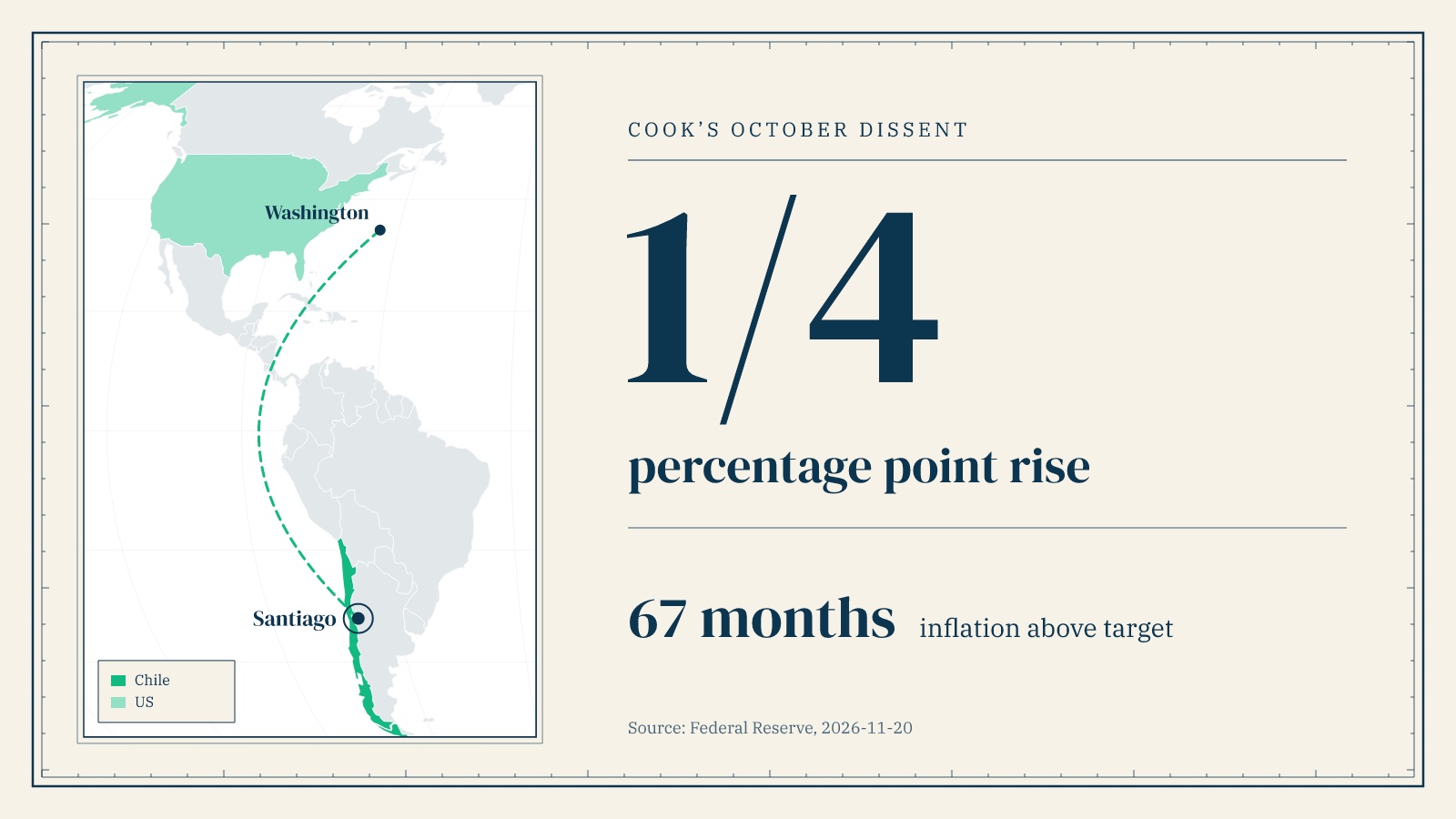
Federal Reserve Governor Cook has explained why she voted against the Fed's decision to keep interest rates unchanged in October. She wanted a small rate rise instead, and she laid out her reasons in a keynote speech in Santiago, Chile, which the Federal Reserve published on 2026-11-20. This article looks at what she said, what a dissent means, and why traders watch speeches like this for clues about the US dollar.
What Cook said about her vote
The Federal Open Market Committee, or FOMC, is the group inside the Fed that sets US interest rates. In September it raised the federal funds target range to 3-3/4 to 4 percent, and Cook said she supported that move. At the October meeting, the committee chose to hold rates steady. Cook disagreed. In her words: "I preferred to raise the target range another 1/4 percentage point."
A dissent is a formal vote against the majority. It does not change the decision, but it shows markets that one policymaker wants a different path. A vote for higher rates is called a hawkish dissent, since hawks worry most about inflation.
Cook gave two reasons. First, she judges financial conditions to be too loose while inflation stays well above the goal, with no clear sign that prices are cooling. She said current policy is not slowing the AI investment boom, and rising share prices keep supporting household spending. In her view, holding rates still is itself a policy choice, as much as a hike would be, and it risks a widening output gap, which means the economy running hotter than it can sustain.
The inflation numbers behind her worry
Her second reason was urgency. Cook noted that inflation has been above the Fed's 2 percent target for 67 months. The longer that lasts, she argued, the greater the risk that businesses and workers start to expect high inflation as normal. She warned that waiting could leave the Fed behind the curve, forcing more and larger hikes later that could strain the financial system and hurt households.
She cited an estimate that the 12-month rise in the PCE price index, the Fed's preferred inflation gauge, was 3.8 percent in October. Core PCE, which leaves out food and energy, was 3.2 percent. She said the latest report showed price gains across many items, from airfare and furniture to hotels and restaurants, and that shocks over the past 18 months, including trade policy shifts and geopolitics, partly reversed earlier progress.
The job market, by contrast, looks steady in her account. She put the October unemployment rate at 4.1 percent, with payrolls up 165,000 that month, and said third-quarter GDP grew at a 3.4 percent yearly rate. Because unemployment is low, Cook said her focus is mainly on the inflation side of the Fed's dual mandate.
Why currencies care
Interest rates are one of the main forces behind exchange rates. When a central bank pays higher rates, holding that currency tends to earn more, so global investors may want more of it. That extra demand can push the currency up. When markets expect lower rates, the opposite pressure can appear.
Markets do not wait for the decision itself. Prices move on expectations. A voting policymaker arguing for a higher rate can make traders see further hikes as more likely, and the dollar can react within minutes. If other speakers sound more cautious, the move can reverse just as fast.
Here is how that looks on a quote screen. In EUR/USD, the euro is the base currency and the US dollar is the quote currency. The price tells you how many dollars one euro buys. If the dollar strengthens, one euro buys fewer dollars, so EUR/USD falls. In USD/JPY the dollar is the base currency, so a stronger dollar makes that pair rise. The same dollar news can push two pairs in opposite directions, which confuses many beginners.
These moves are measured in pips. For most pairs, including EUR/USD, a pip is a change in the fourth decimal place of the price; for yen pairs it is the second decimal place. The money value of each pip depends on your trade size, which is why a sharp move on a news day can matter far more to a large position than its small size on the chart suggests.
Beginner risk check
Speeches and rate decisions are some of the riskiest moments in the forex calendar. Before trading around them, keep three things in mind.
- Volatility: prices can jump in both directions within seconds, and the first move is often reversed.
- Spreads: the gap between the bid and ask price can widen sharply around news, so each trade costs more.
- Leverage: borrowed exposure magnifies every pip, so leveraged forex trading can lose money quickly and a fast move can wipe out a small account. Many beginners simply watch from a demo account on these days.
What to watch next
The Federal Reserve did not set out a next step in this speech, and one dissent does not decide future policy. Watch how other Fed officials describe inflation, and whether Cook's view stays a minority opinion. Cook also stressed that global shocks, such as energy swings, wars and trade restrictions, affect the US economy, a reminder that the dollar reacts to news far beyond Washington.
Sources
- Federal Reserve, 20 Nov 2026
This article was produced by AI from the cited sources and published automatically after automated checks (figures traced to sources, no copied phrasing); it was not edited by a person. It is beginner education, not trading advice.