
News analysis ·
Fed's Jefferson on AI and the Neutral Rate, Explained
Fed policymaker Jefferson linked AI, productivity and the neutral rate. We explain what r* is and why it matters for the dollar.
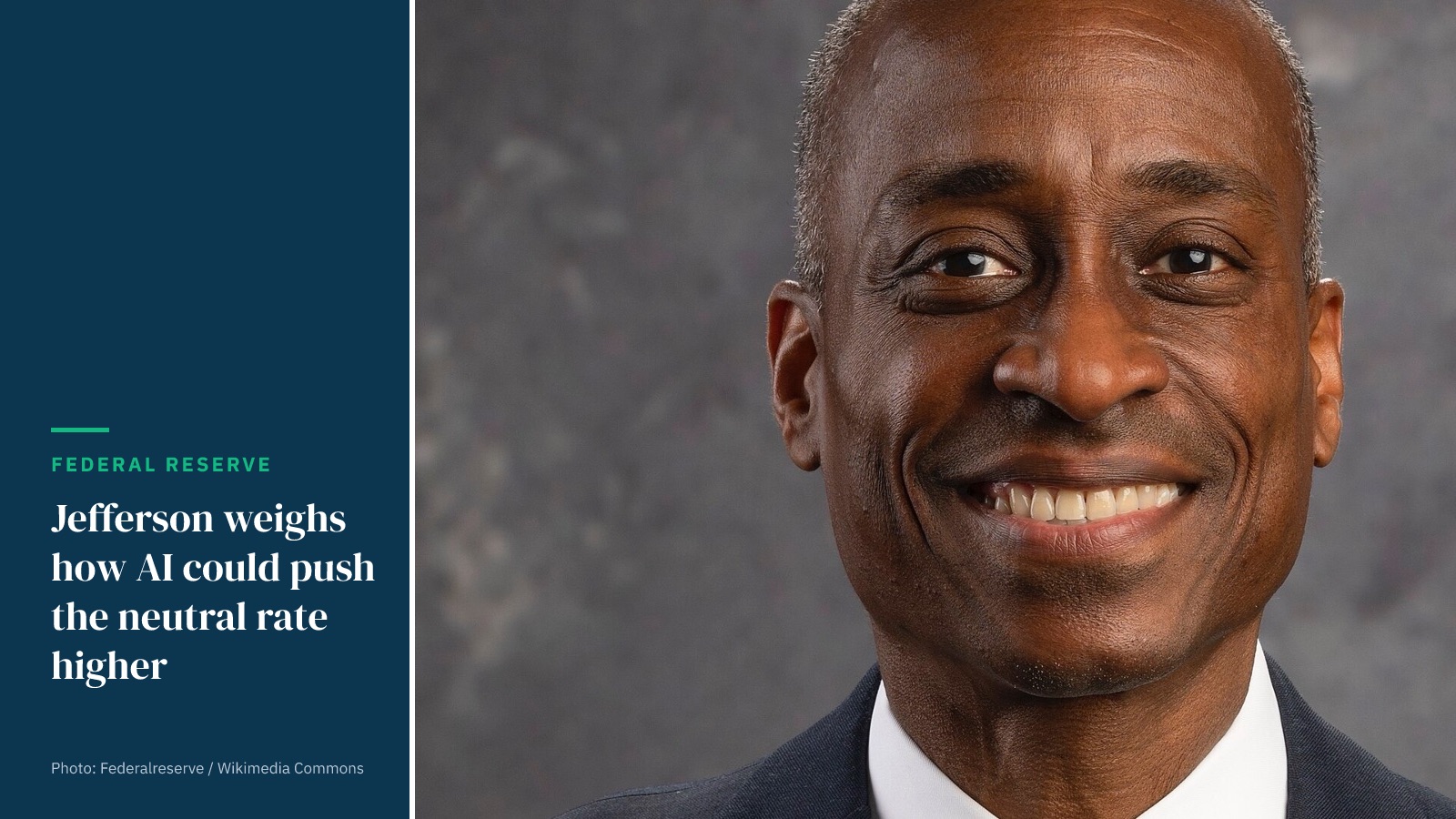
Federal Reserve policymaker Jefferson used a talk at a University of California, San Diego economic roundtable to ask how artificial intelligence might change the US economy and what that could mean for interest rates. The Federal Reserve published the speech dated 2026-11-14. This article explains the idea at its centre, the neutral rate, and why it matters to anyone learning how currencies move.
What Jefferson said about AI and the economy
Jefferson's starting point was history. He reminded the audience that spending on information technology added roughly 3/4 percentage point a year to labor productivity growth during the late-1990s boom. Productivity simply means how much output each worker produces. The catch, he noted, is that researchers only confirmed that link afterwards.
He sees a similar puzzle today. Worker surveys he cited show 40 to 50 percent of working US adults use generative AI on the job, but only a modest share use it daily. A Census Bureau survey put use at roughly 25 percent of all US firms, near 40 percent in knowledge-heavy sectors and around 10 percent in mining and hospitality.
US output per worker grew at an average 2.2 percent pace from 2020 through 2025, up from 1.5 percent in the prior business cycle. Jefferson cautioned that this pickup began before popular chatbots arrived in 2022, so the role of AI is unclear. One manager survey he mentioned found AI lifted sales per employee by only 1/2 percent over three years. His overall judgement: AI adds little to productivity so far, but it could grow a lot, and both the size and timing are highly uncertain.
Demand now, supply later: the inflation angle
For a central banker, the near-term story is about prices. Jefferson said AI-related spending, including the construction of data centers and wealth gains from rising stocks, is boosting demand and adding upward pressure on prices. Memory and logic chips have seen steep increases. He expects those pressures to ease over the medium term as chip supply catches up and productivity gains arrive.
He also flagged a risk. AI could displace workers faster than they can retrain, which would push unemployment up. Here he drew a clear line around what a central bank can do: "Monetary policy can affect cyclical conditions, like a temporary downturn in employment and spending, but it cannot address the structural factors". In plain terms, rates can soften a temporary slump, not fix a lasting skills mismatch.
The neutral rate in plain English
The most useful part of the speech for a beginner is the neutral rate, often written as r*. It is the interest rate that neither speeds up nor slows down the economy. Think of it as the point where the brake and the accelerator are both released.
Jefferson explained that the neutral rate shapes how tight policy really is. If r* rises, the same federal funds rate (the Fed's main policy rate) becomes looser in effect. If r* falls, that same rate becomes tighter. So the Fed can hold its rate steady while the true stance of policy quietly shifts underneath it.
Why might AI move r*? According to Jefferson, lasting faster productivity growth could lift business demand for investment and reduce household saving. More borrowing demand and less saving would likely push the neutral rate higher. He added that forecasting r* is hard, because the historical link between productivity and real interest rates is noisy.
Why currencies care
Currencies respond to interest rates because money tends to flow towards places where it earns more, all else equal. When markets expect US rates to stay higher than rates elsewhere, holding dollars becomes more attractive in principle. When they expect US rates to fall relative to other economies, that support can fade. This gap between two countries' rates is called the interest rate differential.
The neutral rate matters because it changes how traders read the Fed's future path. If policymakers came to believe r* had risen, a rate that once looked restrictive might look only mildly tight, and the case for cutting could weaken. In a pair such as EUR/USD, the dollar is the quote currency, so shifting views about US rates can move the pair even when nothing in Europe has changed. These are mechanisms, not forecasts. Many other forces move currencies, and Jefferson himself stressed the uncertainty.
Beginner risk check
Speeches by Fed officials can move the dollar, especially when they touch on rates. A few points to keep in mind on such days:
- Volatility can jump within minutes of a headline, and prices may move further than a beginner expects.
- Spreads often widen around major news, so the cost of opening or closing a trade can rise suddenly.
- Leverage magnifies every move. A small swing against a highly leveraged position can wipe out a large share of an account.
Central bank speech days are high-risk days. Leveraged forex trading can lose money quickly, and a reader can lose money even when a move looks small.
What to watch from here
This speech set out no new decision. Jefferson's message was that policymakers must keep watching incoming developments to judge whether the neutral rate is shifting. For beginners, the useful habit is to notice how Fed officials describe r* over time, and how the dollar reacts when that language changes.
Sources
- Federal Reserve, 14 Nov 2026
This article was produced by AI from the cited sources and published automatically after automated checks (figures traced to sources, no copied phrasing); it was not edited by a person. It is beginner education, not trading advice.