
News analysis ·
Fed's Waller Eyes a December Hike: The Dollar Angle
Fed Governor Waller backs a December rate hike and floats a larger step. We explain why rate talk moves the dollar and why news days are risky.
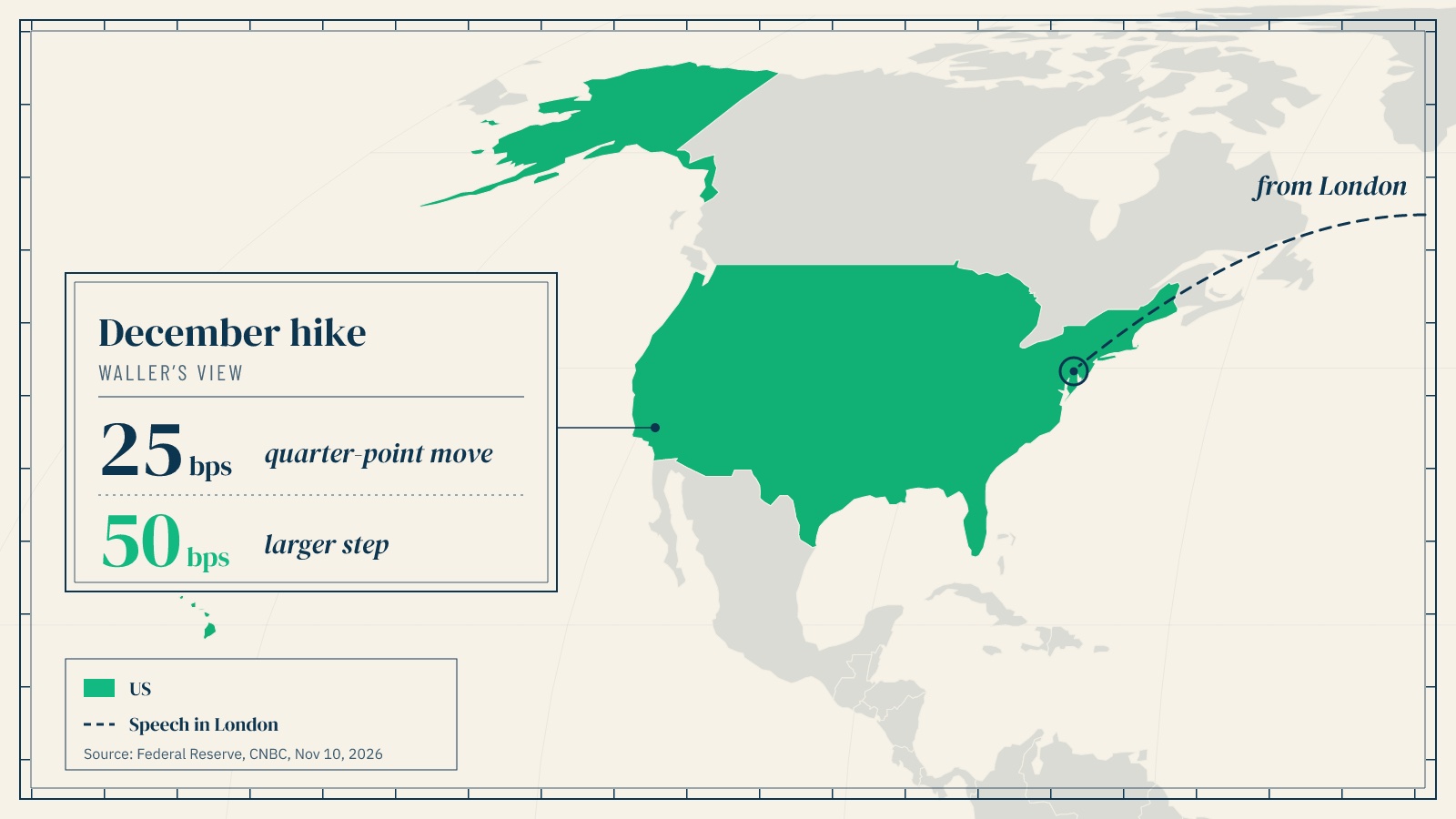
Federal Reserve Governor Christopher Waller said he expects to support a rate increase at the Fed's December meeting, and CNBC reported he would consider a larger step if inflation runs hot. This article explains what he said, why words like these matter for the US dollar in principle, and why beginners should treat these days with extra care.
What Waller said in London
Waller spoke at the Bank of England Watchers Conference in London, hosted with King's Business School. According to the speech published by the Federal Reserve, the US economy is growing strongly but inflation is still too high, so he sees more tightening, meaning higher rates, as needed fairly soon to guide inflation toward 2 percent.
He said that even if October consumer price data improved on September, he would still favour a 25 basis point increase at the December meeting. A basis point is one hundredth of a percentage point, so this is a quarter-point move. CNBC reported that Waller went further: if inflation readings came in hotter than expected, a 50 basis point hike should be considered. He explained the stakes in plain words: "Hiking only 25 basis points would put our credibility at risk, a risk I am not eager to take."
Why he waited, and why that matters
When the FOMC, the Fed committee that sets US rates, last met, Waller voted with the majority to leave the rate unchanged. His reasoning was that the Fed's own signals had already led markets to price in some tightening. In his view, hikes do not need to come at back-to-back meetings. But promised increases must actually happen within a reasonable time. If they do not, market interest rates would fall back and policy would loosen when the Fed does not want it to.
The lesson for beginners: a speech can matter almost as much as a meeting, because it changes what traders expect.
The data behind the worry
Waller pointed to September inflation measured by PCE, the gauge the Fed targets. It rose 0.5 percent for the month and 3.7 percent over 12 months. Core PCE, which strips out food and energy, was 0.3 percent and 3.1 percent. He called the September figures bad, with no bright spot, and said he was especially worried by how widespread price rises had become.
Growth and jobs look solid in his telling. Real GDP grew 3.4 percent in the third quarter on the first estimate, unemployment was 4.1 percent in October, and 165,000 jobs were added. He described the job market as stable but low hire, low fire, and openly asked whether stable also means healthy, without giving a firm answer.
CNBC also said October CPI rose 0.4%, above the 0.3% economists expected, while core CPI gained 0.3% against a 0.2% forecast. CNBC reported that the 2-year Treasury yield, which closely follows short-term Fed expectations, ended at 4.736%, up more than 18 basis points on the day.
Why currencies care
Here is the basic link, explained simply. When a central bank raises its rate, or is expected to, savings and bonds in that currency tend to pay more. In principle that can make the currency more attractive to hold, because global investors chase better returns. Expectations of lower rates can work the other way.
For forex, that matters because currencies always trade in pairs, such as EUR/USD or USD/JPY. If traders start to expect a faster pace of Fed hikes, the dollar side of the pair can react. In EUR/USD the dollar is the quote currency, so a stronger dollar would show up as a lower price. In USD/JPY the dollar is the base currency, so it would show up as a higher price. The size of any move is measured in pips, the small price steps quoted by brokers.
The key word is expectations. CNBC said markets had already largely priced in a quarter-point December hike, citing the CME Group FedWatch tool. So the surprise, if any, lies in whether the Fed does more or less than that. Nothing here tells you which way a pair will move, and a priced-in hike can leave a currency flat or even weaker.
Beginner risk check
Days with Fed speeches, inflation releases and rate decisions are some of the most dangerous for new traders. Keep three points in mind.
- Volatility: prices can jump sharply in seconds when data or a comment surprises the market, and they can reverse just as fast.
- Spreads: the gap between the bid and ask price often widens around big releases, so every trade costs more and stop orders can fill at worse prices.
- Leverage: borrowed exposure magnifies a sudden move, so a small account can lose a large share of its value on a single headline.
Leveraged forex trading can lose money quickly, and news days are when losses tend to come fastest.
What comes next
CNBC noted that wholesale inflation numbers due Friday, together with the CPI release, may shape the Fed's next decisions. Lindsay Rosner of Goldman Sachs Asset Management told CNBC that a December hike is the firm's base case and that further hikes in 2027 cannot be ruled out. The December meeting itself is the next big date for dollar watchers.
Sources
- Federal Reserve, 10 Nov 2026
- CNBC, 10 Nov 2026
This article was produced by AI from the cited sources and published automatically after automated checks (figures traced to sources, no copied phrasing); it was not edited by a person. It is beginner education, not trading advice.