
News analysis ·
FX Settlement Risk: What Project Meridian Tested
The Bank of England, MAS and Bank of Thailand tested a new way to settle currency trades. What settlement risk is and why forex beginners should know it.
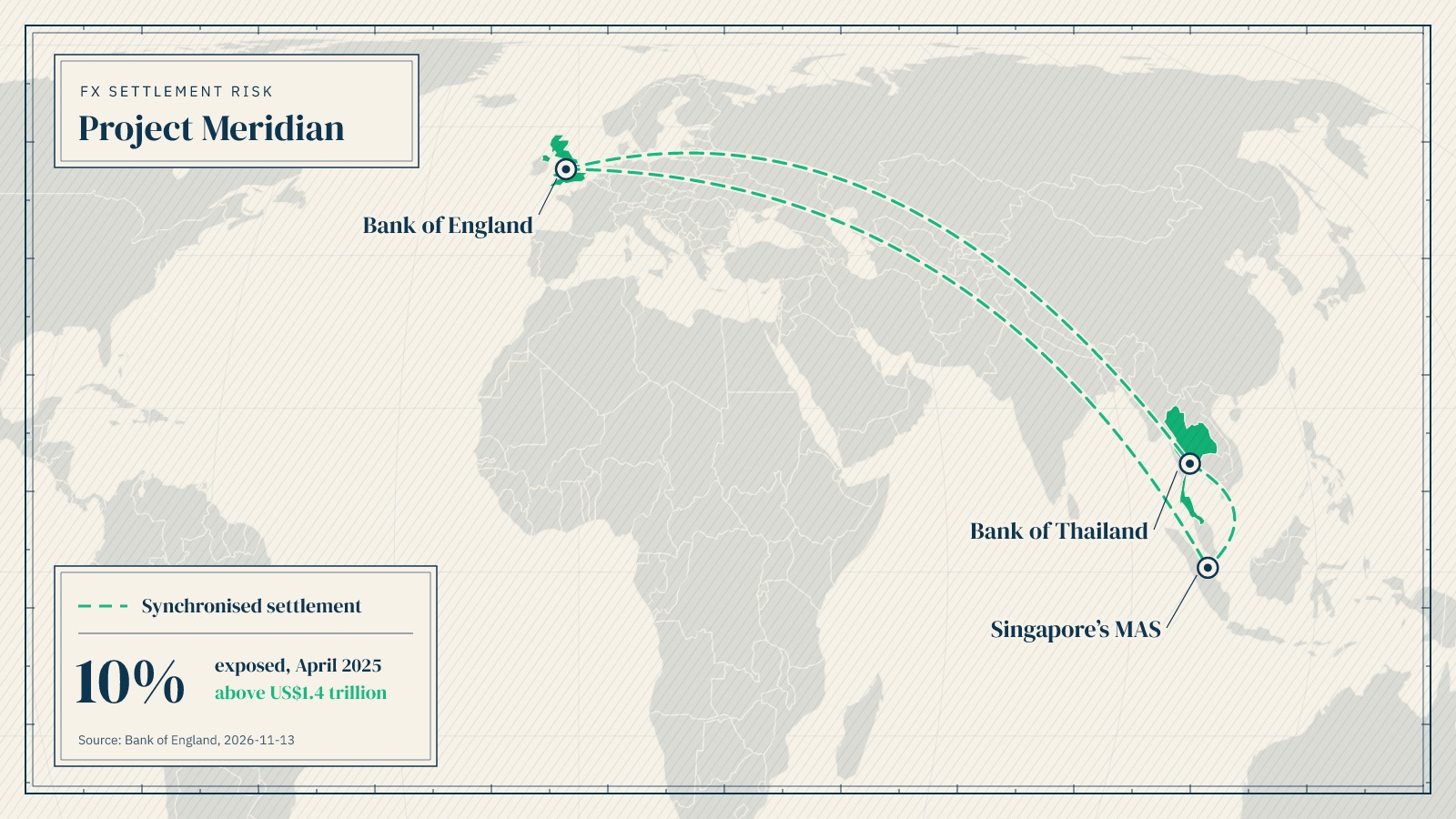
Three central banks have published the results of a joint trial on how currency trades are settled between banks. According to the Bank of England, the test, called Project Meridian FX APAC, showed one way to make sure both sides of a currency deal are paid at the same moment. This article explains what was tested, what settlement risk means, and why it matters even to someone who has never placed a trade.
What the three central banks tested
Britain's central bank, the Bank of England, released the findings together with Singapore's MAS and the Bank of Thailand on 2026-11-13. The trial looked at an idea called synchronisation. In simple terms, this is a service that coordinates transfers of central bank money held in different systems, so linked payments move together.
Each country runs its own settlement system. Some are classic real-time gross settlement (RTGS) systems, where large bank payments are settled one by one. Others use distributed ledger technology. The trial tested whether a single coordinating layer could link these very different systems. The Bank of England said the project covered more currencies, technologies, infrastructures and time zones than earlier work.
A firm called Partior built and tested a prototype Synchronisation Operator for the trial: a coordination layer that makes linked transfers either all happen, or none happen.
Settlement risk, explained for beginners
Every currency trade has two legs. If a bank sells euros for dollars, it pays out euros and expects to receive dollars. Settlement is the moment the money actually changes hands. The danger is simple: one bank pays its leg, and the other leg never arrives. That gap is called settlement risk.
The fix the trial focused on is called payment-versus-payment, or PvP. Under PvP, one currency moves only if the other currency in the trade moves too. Neither side can be left having paid without being paid.
This is not a small corner of the market. The Bank of England cited a 2025 survey of central banks by the BIS. It found that in April 2025, 10% of average daily FX settlement, above US$1.4 trillion, was still fully exposed to settlement risk.
Here is the part most beginners never hear. When you open a EUR/USD position with a retail broker, you do not receive euros or send dollars. You hold a price position, and your gain or loss is booked in your account currency. The real exchange of currencies happens far upstream, between large banks. That plumbing is what Project Meridian is about. It does not change the price you see on a chart, but it is part of why the market behind that chart can function safely across countries and time zones.
Why currencies care about this kind of news
Most central bank news that moves currencies is about interest rates and inflation. Higher expected rates can make a currency more attractive to hold, and surprises on inflation can shift those expectations quickly. A settlement trial is a different kind of story. It is about the safety and cost of moving money, not about the price of money.
That is useful when reading headlines. Not every central bank announcement is a signal about rates. Sorting news into policy news, which can move a currency pair, and infrastructure news, which usually does not, is a good first habit.
The trial also tested multilateral netting. Instead of each bank paying every other bank in full, payments are offset against each other first, so fewer and smaller transfers are needed. The central banks said this helps banks use their liquidity more efficiently. Tom Mutton, who leads payments and innovation work at the Bank of England, said: "Project Meridian FX APAC provides practical evidence of how synchronised settlement could help reduce risk and improve efficiency in cross-border FX transactions."
Beginner risk check
Infrastructure news like this rarely creates a big price move. But central bank headlines of any kind arrive on days that can be busy for other reasons. Keep these points in mind:
- Volatility: if a rate decision or inflation release lands on the same day, prices can jump in seconds.
- Spreads: the gap between the bid and ask price often widens around major news, so a trade costs more to open and close.
- Leverage: small price moves are magnified on a leveraged account, so leveraged forex trading can lose money quickly. A fast news move can hit a stop loss or trigger a margin call.
What comes next
The Bank of England intends to have a live synchronisation interface running in 2028, and says these findings show how such a service could be developed. The results are set out in three reports: an introduction and executive summary, a technical report and a policy report.
Possible next steps include more jurisdictions and industry participants, more currencies and transaction types, and the legal arrangements needed in practice. The banks also flagged requirements and trade-offs, so this is a tested approach, not a finished system.
Sources
- Bank of England, 13 Nov 2026
This article was produced by AI from the cited sources and published automatically after automated checks (figures traced to sources, no copied phrasing); it was not edited by a person. It is beginner education, not trading advice.