
News analysis ·
Lagarde's 'measured response': what it means for the euro
ECB chief Lagarde says energy-driven inflation needs a measured response. We explain her signal, why the euro reacts to rate talk, and beginner risks.
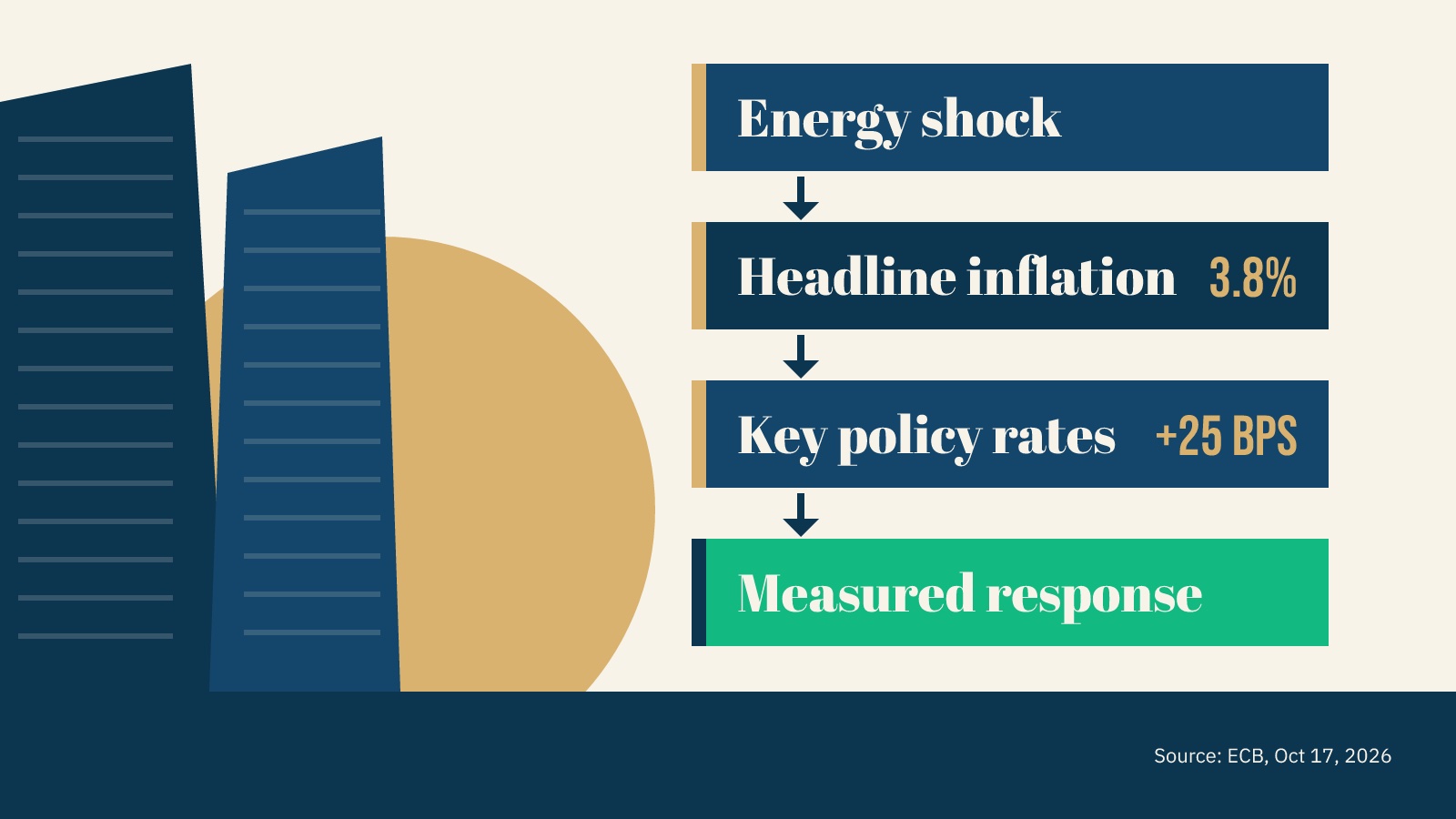
European Central Bank President Christine Lagarde has told the IMF's ministerial steering committee that an energy-driven jump in inflation calls for a careful, step-by-step policy response. The written statement, published by the ECB on 2026-10-17, repeats that rates went up in June and again in September. This article looks at what she actually signalled, how to read the inflation figures she gave, and why a central bank's words can move the euro.
What Lagarde told the IMF committee
The IMFC is a group of finance ministers and central bankers that steers the work of the International Monetary Fund. Lagarde's statement, released by the ECB, covered growth, inflation, rates and financial risks in the euro area.
On policy, the core message was this. The ECB Governing Council, the group that sets euro area rates, raised its key rates by 25 basis points in September, after a move of the same size in June. A basis point is one hundredth of a percentage point, so 25 basis points is a quarter of a point.
Her summary of the stance was that the energy shock is too big to simply look past, yet the right answer is still a careful, gradual one. In plain English: the ECB cannot just wait for the energy spike to fade, but it does not plan sudden, oversized moves either.
How to read the inflation numbers she gave
According to the ECB, headline inflation in the euro area rose to 3.8% in September. Headline inflation counts everything in the shopping basket, including energy and food. Most of the rise came from energy, with smaller pushes from food and services.
Core inflation, which leaves out the most volatile items such as energy, edged up to 2.5%. Central banks watch core because it shows whether price pressure is spreading. Lagarde also said wages had not yet reacted in a material way to the energy shock. That matters, because rising wages can keep inflation high long after an energy spike fades.
The ECB expects headline inflation to stay well above its goal through the first half of 2027 and to come back to around target late in 2027. Lagarde said the risks to inflation lean upward, citing the Middle East conflict and Russia's war against Ukraine, while the risks to growth lean downward. ECB staff projections from September put euro area growth at 0.9% for 2026, rising to 1.4% the next year and 1.5% in 2028.
What she did not promise
Lagarde did not set out a fixed path for rates. She said future decisions will come from a full assessment of incoming data, judged against three tests: the inflation outlook and its risks, how underlying inflation is behaving, and how strongly policy is passing through to the economy.
She also pointed to a force working the other way. Borrowing has become harder and costlier, and long-term interest rates have climbed notably since the previous meeting. She expects this to slow growth more than the September projections assumed. Beginners should notice the balance: the message holds reasons both to take inflation seriously and to go carefully.
Why currencies care about this kind of statement
A currency's value is partly about what you earn by holding it. When a central bank raises rates, deposits and bonds in that currency can pay more, which can, in principle, attract money from abroad and support the currency. When markets expect fewer or smaller hikes, that support can weaken.
This is why traders read words like measured so carefully. Prices in the currency market already reflect what people expect the ECB to do. A statement mostly moves the euro when it changes those expectations. If the wording matches what markets assumed, the reaction can be small. If it sounds more hawkish (leaning toward higher rates) or more dovish (leaning toward lower rates) than expected, the euro can swing in either direction.
A pair such as EUR/USD compares two economies, so news about the other currency can outweigh even a clear ECB message. Lagarde also said the ECB's enhanced EUREP repo line for foreign central banks has drawn interest from more than 30 central banks in six months, and that it supports the euro's international role.
Beginner risk check
Central bank statements and rate days are some of the riskiest moments in the currency market for new traders. Keep these points in mind:
- Volatility: prices can jump sharply in seconds when a statement surprises the market, and they can reverse just as quickly.
- Spreads: brokers often widen the gap between the buy and sell price around big announcements, so trading costs rise exactly when moves are fastest.
- Leverage: borrowed exposure turns a quick swing into a large loss on a small account, and a stop loss may be filled at a worse price than set.
Leveraged forex trading can lose money quickly, and you can lose more than you expected on a news day. Watching how the euro reacts on a demo account, without real money, is a safer way to learn how central bank news feeds into prices. None of this is a signal to trade.
Sources
- ECB, 17 Oct 2026
This article was produced by AI from the cited sources and published automatically after automated checks (figures traced to sources, no copied phrasing); it was not edited by a person. It is beginner education, not trading advice.