
News analysis ·
India's central bank defends the rupee: USD/INR explained
The Reserve Bank of India took new steps to slow the rupee's fall. We explain how intervention works and how to read USD/INR as a beginner.
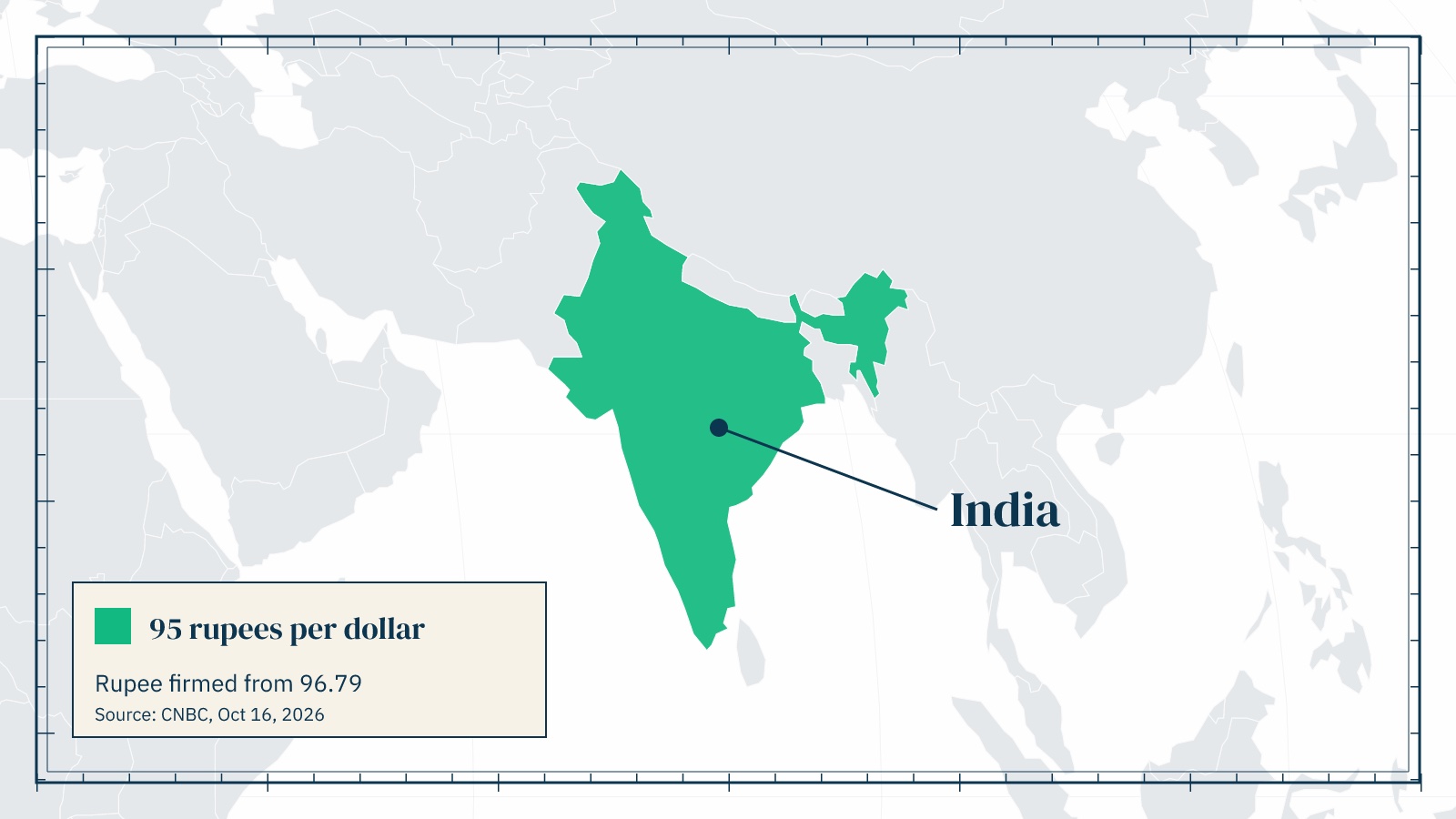
The Reserve Bank of India (RBI) has rolled out new measures to slow the rupee's slide against the US dollar, CNBC reported. The currency has bounced in recent days, but strategists say the pressure behind the fall has not gone away. This article looks at what the RBI did, how a central bank can lean against its own currency's moves, and what that means for a beginner looking at the USD/INR pair.
What the RBI did
On Saturday the RBI announced two kinds of steps, according to CNBC. The first makes it more expensive to hold speculative positions against the rupee. It also limits the rebooking of foreign exchange derivative contracts that have been cancelled. In plain terms, it is harder and costlier to bet on a weaker rupee.
The second step targets real demand for dollars. The RBI opened a special window that covers all the daily dollar needs of three state-run oil marketing companies. Those firms buy dollars to pay for imported fuel. By serving them directly, the central bank keeps that large, steady buying out of the open spot market, where it would otherwise push the dollar up against the rupee.
RBI governor Sanjay Malhotra set out the bank's stance in an interview with the Indian outlet Moneycontrol on Tuesday: "The RBI is determined to do whatever is necessary to ensure orderly movement in the foreign exchange market". The bank is not promising a fixed level. It is trying to stop fast, disorderly moves.
The rupee has since firmed from 96.79 per dollar back to around the 95-level, CNBC reported.
Why currencies care: how a central bank fights a falling currency
A currency's price is set by supply and demand, like anything else. When more people want to sell rupees and buy dollars than the other way round, the rupee weakens. India imports nearly 85% of its fuel, so a high energy bill means a constant need for dollars. Foreign investors leaving the stock market add to that demand: they sold $32.5 billion of Indian equities this year through Oct. 13, according to NSDL data cited by CNBC.
A central bank has a few tools to push back. It can sell dollars from its foreign exchange reserves and buy rupees, which adds supply of dollars to the market. It can make speculation more costly, as the RBI just did. It can also try to attract dollars in. In June the RBI ran a deposit scheme for non-resident Indians, known as FCNR-B, which lifted reserves by $105 billion.
The catch is that reserves are finite. Since that scheme closed on Aug. 30, the rupee has lost 1.9% versus the dollar, and dollar sales to defend it cut reserves by $51 billion as of Oct. 2, according to Ambit Capital. Ambit also said FCNR-B and swap measures from June created forward dollar commitments of $200 billion, which shrink the RBI's effective cover. India's import cover is about 6.2 months, the lowest since the 2013 US taper tantrum, Ambit said.
Reading USD/INR the right way round
Beginners often get this backwards. In USD/INR, the US dollar is the base currency and the rupee is the quote currency. The price tells you how many rupees one dollar buys. So when USD/INR goes up, the rupee is getting weaker, not stronger. A move from 96.79 to around 95 means the rupee gained ground.
USD/INR is not a major pair like EUR/USD. It trades with heavier central bank involvement and rules that differ from the majors. That can make it behave differently: calm stretches can end in sudden jumps when policy changes.
What analysts quoted by CNBC said
Strategists told CNBC the measures bring short-term relief, but pressure from oil costs, a wider current account gap and weak capital flows remains. HDFC Securities research head Devarsh Vakil described the steps as stability for the short to medium term rather than structural support.
S&P Global Market Intelligence, through Hanna Luchnikava-Schorsch, projects roughly 97 rupees to the dollar at end-2026, then 98 rupees by mid-2027. Mizuho Securities strategist Vishnu Varathan said his firm also expects about 98 rupees per dollar by late 2026 and early next year. Luchnikava-Schorsch said a move to 100 rupees per dollar cannot be excluded if oil climbs further, portfolio outflows return and the deficit widens. These are the firms' own views, and forecasts like these are often wrong.
Harsimran Sahni of Anand Rathi Global Finance said the rupee may stay under pressure through the financial year ending March 2027. Sahni added that intervention can calm volatility but cannot offset external imbalances forever.
Beginner risk check
Central bank action on a currency creates exactly the kind of day a beginner should treat as high-risk.
- Volatility: a new measure or a surprise intervention can move a pair sharply in minutes, in either direction.
- Spreads: pairs outside the majors usually have wider spreads, and they can widen further when news hits, so the cost of a trade rises.
- Leverage: borrowed exposure magnifies a sudden move, and a policy shock can trigger a margin call before you can react.
Leveraged forex trading can lose money quickly,. If you are still learning, watching how USD/INR reacts on a demo account teaches more than risking real money on a policy headline.
Sources
- CNBC, 16 Oct 2026
This article was produced by AI from the cited sources and published automatically after automated checks (figures traced to sources, no copied phrasing); it was not edited by a person. It is beginner education, not trading advice.