
News analysis ·
Singapore rejects a weaker currency: what it means
Singapore's prime minister ruled out a weaker Singapore dollar. We explain how the MAS steers its currency and why it matters to forex beginners.
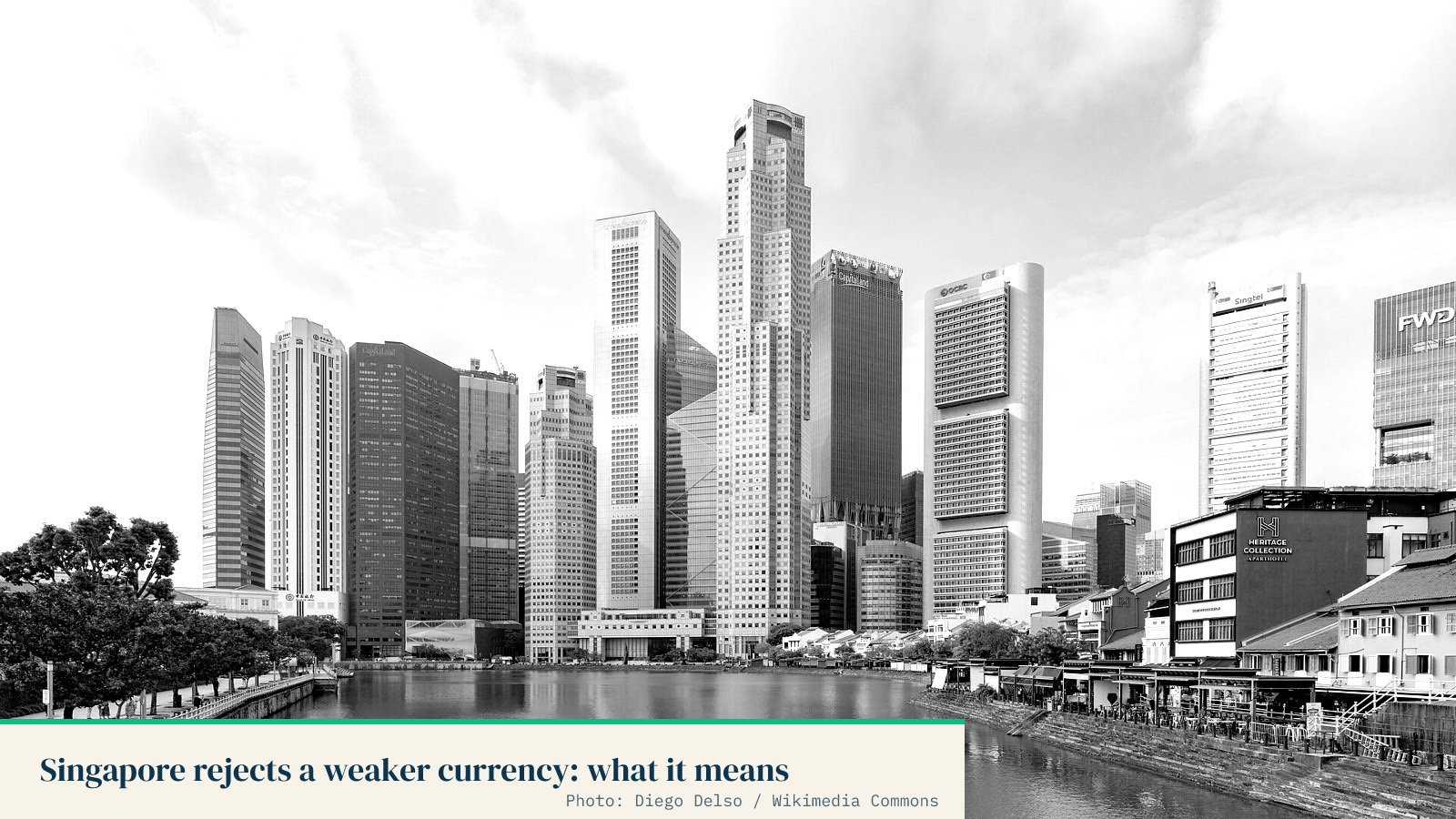
Singapore's Prime Minister Lawrence Wong has said the country will not push its currency lower to help exporters compete, CNBC reported. That sounds like a small remark, but it points to an unusual way of running monetary policy. This article looks at how Singapore steers its money through the exchange rate, what a strong currency does to prices and exporters, and why beginners should stay careful around this kind of news.
What Singapore's leader said
Wong spoke on Monday at a conference in Singapore hosted by the bank DBS. According to CNBC, the topic came up in an exchange with DBS chief executive Tan Su Shan. Tan noted that Singapore is seen as a safe haven, a place where investors park money when they want safety. That flow of capital has supported the local currency. She also noted that the city-state is an expensive place to do business.
Wong's answer was clear. Singapore will not make its currency weaker on purpose to win on cost. He said the Monetary Authority of Singapore, known as the MAS, will set policy independently, and the currency will follow the strength of the economy. In his view, a firm and steady Singapore dollar also helps keep down inflation that comes in through imported goods.
He did not pretend this is free. Wong said exporting companies have to treat currency strength as one more cost of being in Singapore, and he admitted the country is not the cheapest location in Southeast Asia. His case was that Singapore should compete on value instead. "Companies are not looking for the cheapest locations," Wong said. He pointed to capabilities, stability and predictability, and to industrial networks that link multinationals, local suppliers, research and skilled workers.
A central bank that steers the currency, not rates
Most large central banks, such as those in the United States or Europe, manage the economy mainly by moving interest rates up or down. The MAS works differently. As CNBC explained, it runs policy through the exchange rate, which is simply the price of one currency in terms of another.
The MAS tracks the Singapore dollar against a weighted group of currencies from the country's main trading partners. It lets the currency move inside a range, called a policy band. The band's exact width is not made public. Because policy runs through the currency, the exchange rate is the main thing the MAS steers.
Why choose this tool? CNBC noted that Singapore depends heavily on trade and imports. Much of what people buy there comes from abroad. So the exchange rate feeds quickly into local prices.
Why currencies care: prices, inflation and exporters
Here is the basic link. When a currency gets stronger, each unit buys more foreign goods. Imports become cheaper in local terms. That helps hold inflation down, especially when prices are rising around the world. This is the benefit Wong described.
The cost sits on the other side of the trade. A stronger currency makes goods and services made in Singapore more expensive for foreign buyers. Exporters then face pressure on sales or margins. Wong accepted this trade-off.
Many countries face the same choice in a quieter form. A weaker currency can help exporters for a while, but it also makes imports dearer and can add to inflation. Singapore has said, in plain terms, which side it prefers. For context, CNBC reported that the Singapore dollar has gained almost 0.4% against the U.S. dollar since the start of the year. That is a modest move, not a dramatic one.
Beginner risk check
Comments like these do not change policy on their own. Still, any statement about a currency from a leader or central bank can move prices, and news days are when beginners often get hurt. Keep these points in mind.
- Volatility: prices can jump quickly when officials talk about a currency, and moves can reverse just as fast.
- Spreads: the gap between the buy and sell price can widen around news, so trading costs rise exactly when things feel urgent.
- Leverage: borrowed exposure magnifies every small move, so a sharp swing can wipe out a large part of a small account. Leveraged forex trading can lose money quickly.
A clear statement of policy is a lesson in how a currency is managed. It is not a signal to trade. If you want to practise reading pairs like the U.S. dollar against the Singapore dollar, a demo account lets you watch how quotes behave on news days without risking money, because real trading can lose money.
What to watch from here
CNBC's report did not name a date for the next MAS policy decision, so there is no fixed event to circle from this story. What beginners can watch is the pattern. Singapore's leaders have signalled that the currency is meant to reflect the economy, with the aim of keeping imported inflation in check. If you follow this pair, read official MAS statements first, and treat commentary around them as background, not a forecast.
Sources
- CNBC, 13 Oct 2026
This article was produced by AI from the cited sources and published automatically after automated checks (figures traced to sources, no copied phrasing); it was not edited by a person. It is beginner education, not trading advice.