
News analysis ·
SNB's 19.1 Billion Franc Profit: Why the Franc Matters
The Swiss National Bank made 19.1 billion francs in Q3. We explain why its profit moves with exchange rates and gold, and what that says about the franc.
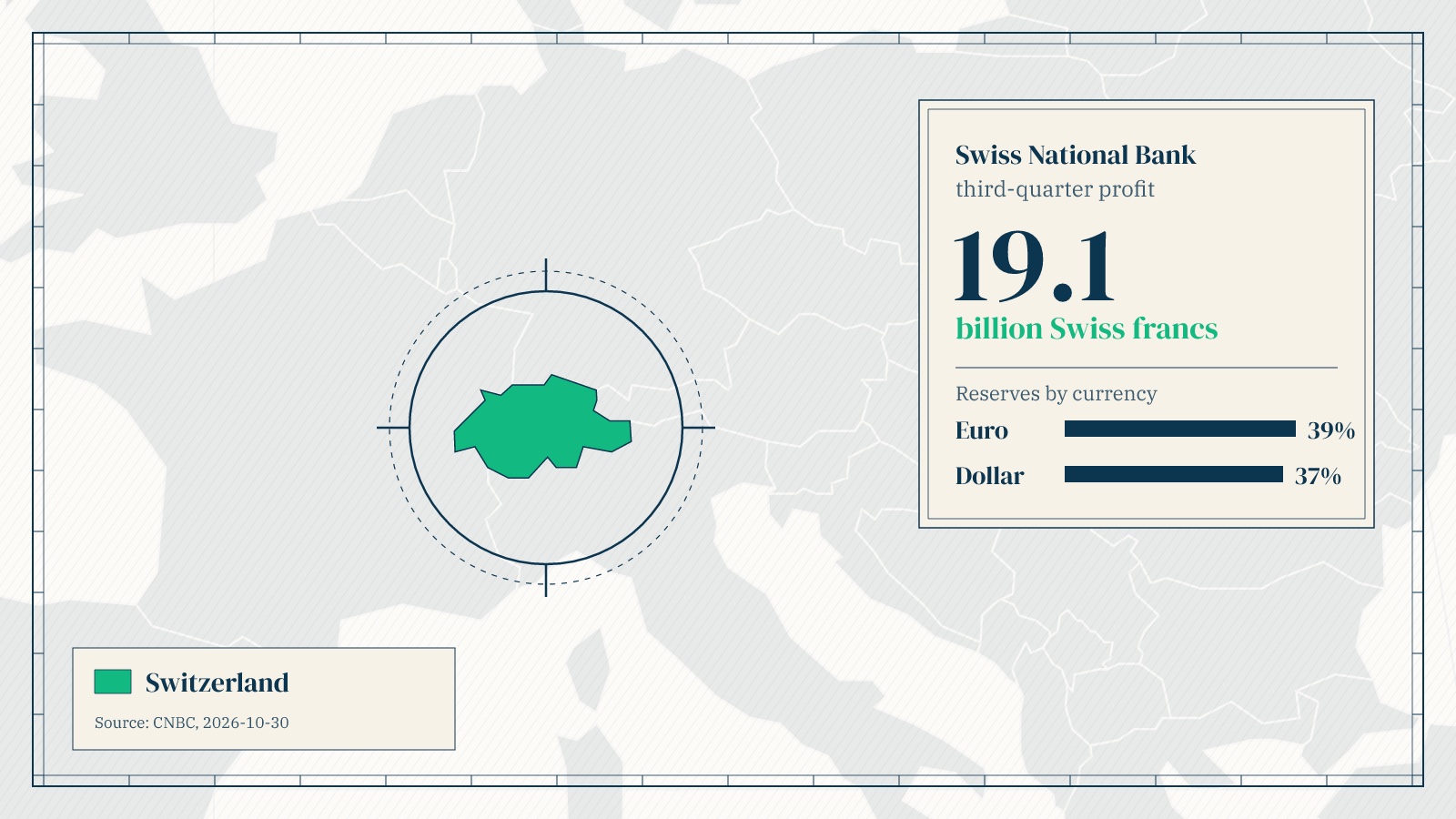
The Swiss National Bank (SNB) earned 19.1 billion Swiss francs on its investments in the third quarter of 2026, CNBC reported, a figure CNBC put at $23.3 billion. The gain came mainly from gold and foreign currency holdings. This article looks at why a central bank's profit rises and falls with exchange rates, and what the result teaches a forex beginner about the Swiss franc.
What the SNB reported
According to CNBC, the SNB's profit for the year so far now stands at 44.2 billion francs, roughly $53.8 billion. That raises the chance of an end-of-year payment to Switzerland's federal and local governments, which receive most of the bank's profits.
The quarter was still weaker than a year before. Third-quarter profit fell by almost 32% compared with the same period of 2025. Gold brought a net gain of 7.6 billion francs for July to September, against 14.3 billion francs a year earlier. Foreign currency positions, which include international shares, earned 11.6 billion francs, about 15% less than a year before.
The SNB itself says profit is not its goal. In words quoted by CNBC from its website: "The monetary policy mandate always has highest priority." Its job is price stability, and it accepts that policy decisions may hurt its annual result.
How exchange rates turn into profit or loss
This is the part most beginners miss. The SNB reports its results in francs, but most of its reserves are assets priced in other currencies. CNBC reported that its result is built from interest income, dividends and valuation changes caused by moves in exchange rates and market prices.
Here is the mechanism in plain terms. Imagine a central bank holds a bond priced in euros. If the euro gains against the franc, that same bond is worth more francs, so the bank books a gain without selling anything. If the franc gains instead, the bond is worth fewer francs, and the bank books a loss. The asset did not change. Only the measuring stick did.
That is why the currency mix matters. At quarter end, euro assets made up 39% of the SNB's portfolio and dollar assets 37%, with the Japanese yen at 7% and the British pound at 6%. So the SNB's result is, in large part, a reading of how the franc moved against the euro and the dollar. Read the pairs EUR/CHF and USD/CHF with that in mind: when the franc is the quote currency and those pairs rise, the franc has weakened, which tends to lift the franc value of foreign holdings.
The franc's path shows the effect. CNBC reported that during 2025 the franc climbed around 12% versus the dollar, as investors sought a safe haven after tariff announcements by U.S. President Donald Trump. So far in 2026 it has given back around 3.6% against the dollar. A weaker franc, in principle, is friendlier to the SNB's franc-measured result.
Why currencies care about the SNB
The SNB is unusual. Unlike many peers, it may use both interest rates and the exchange rate itself to pursue price stability, and CNBC reported it will act on the franc if it judges that necessary. Its inflation target is a range of 0% to 2%, which CNBC described as unusual among major central banks.
For a beginner, the general link is simple. A strong currency makes imports cheaper and can push inflation down. A central bank that worries inflation is too low may want a softer currency, and it can lean on rates or, in the SNB's case, on the exchange rate. That is why traders watch the SNB's statements closely: words about the franc can move CHF pairs quickly.
The reserves also look different from those at the Federal Reserve or the Bank of England, which do not normally hold shares directly. At quarter end the SNB held 61% in government bonds, including central bank and BIS deposits, 28% in equities and 11% in other bonds. It invests passively, tracking a benchmark of international indexes.
Beginner risk check
A profit report is not a policy decision, but central bank news can still move CHF pairs. Keep these points in mind on any SNB news day:
- Volatility: the franc is often treated as a safe haven, so it can move sharply when markets get nervous, not only on Swiss news.
- Spreads: brokers often widen spreads around central bank news, so a trade can start further from break-even than usual.
- Leverage: a fast move against a leveraged position can trigger a margin call before you have time to react. Leveraged forex trading can lose money quickly, and you can lose more than you expected.
None of this is a signal to trade. It is a reason to be careful, or simply to watch.
What to watch next
CNBC did not report a date for the next step, but the year-to-date figure points to the end of the year, when the size of any payout to the federal and local governments becomes clear. A loss year can leave the SNB unable to pay out, so the franc's path in the final months matters for that result too.
Sources
- CNBC, 30 Oct 2026
This article was produced by AI from the cited sources and published automatically after automated checks (figures traced to sources, no copied phrasing); it was not edited by a person. It is beginner education, not trading advice.