
News analysis ·
Waller Calls for a Half-Point Hike: What It Means
Fed Governor Waller told CNBC a half-point hike may be needed in December. We explain why rate talk moves the dollar and why beginners should be careful.
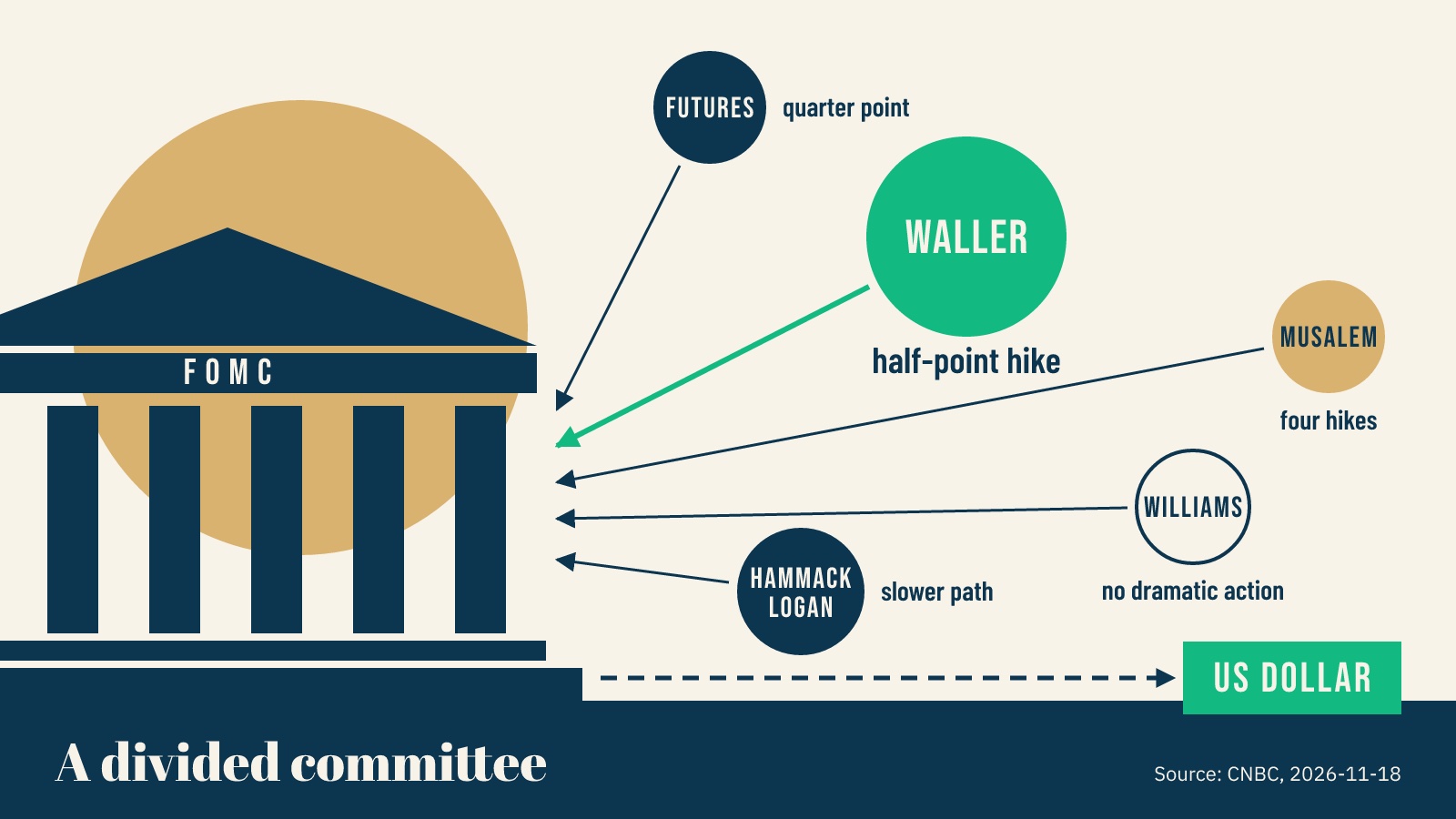
Federal Reserve Governor Christopher Waller said in a live CNBC interview on Wednesday that the Fed should probably raise its benchmark rate by half a percentage point at its Dec. 8-9 meeting. That is twice the size of a quarter-point step. This article explains what he said, how talk like this can move the US dollar in principle, and why the days around a Fed meeting are high-risk for beginners.
What Waller said, and why
Waller is a Fed governor. US interest rates are set by the Federal Open Market Committee, or FOMC. According to CNBC, he told the network that inflation is rising faster than he expected and that the Fed needs to act with force.
"I'm very, very concerned about inflation. It's kind of headed in the wrong direction, and it's spreading out," Waller said.
His case rests on recent history. In 2025 the Fed made three quarter-point rate cuts, partly because of worries about jobs and partly because it expected inflation to settle toward its 2% goal. CNBC reported that inflation instead picked up again this year, after US and Israeli strikes on Iran in late February pushed up energy prices while tariff effects lingered. Most inflation readings have stayed above 3%. Waller argued that the Fed should undo those three cuts and may need to go further.
A divided committee
Waller is not speaking for the whole Fed. The FOMC raised rates in September for the first time in more than three years, then held them steady in October. Since then, officials have offered different views on the pace.
St. Louis Fed President Alberto Musalem suggested in a Tuesday speech that up to four hikes could come by the spring of 2027. Cleveland Fed President Beth Hammack and Dallas Fed President Lorie Logan have backed a slower path, CNBC said. New York Fed President John Williams told Axios on Tuesday that he does not see a need for dramatic action and that the current approach is working.
There is also a debate about signalling. Waller said a half-point move would not be needed if the Fed raised rates by a quarter point and clearly flagged another step in January. This kind of advance signal is called forward guidance. CNBC noted that Fed Chairman Kevin Warsh opposes it because he believes it limits flexibility. For markets, that disagreement adds uncertainty about what the December statement will look like.
Why currencies care about rate hikes
A currency is partly a price for holding money in that country. When a central bank raises its rate, cash and short-term bonds in that currency tend to pay more. In principle, that can make the currency more attractive to global investors, so higher expected rates can support it.
The key word is expected. Markets try to price the future before it arrives. According to the CME Group FedWatch gauge cited by CNBC, futures already fully price a quarter percentage point hike in December, another move in January, and at least one more before the end of 2027. That means a quarter-point hike alone would not be a surprise. What tends to move a currency is the gap between what traders expected and what actually happens.
This is why a speech can matter. When an official like Waller argues for a bigger step, traders may adjust their expectations, and the dollar can react in minutes. Other voices on the committee can pull those expectations back. The direction is never certain, and other forces, such as risk mood or news from other countries, can outweigh rate talk.
Reading the move in pips
Beginners usually see these reactions as changes in a currency pair, such as EUR/USD. The move is measured in pips. A pip is the smallest standard price step for most pairs, and the money it represents depends on your position size. On a quiet day a pair may drift a little. Around a Fed decision, the same pair can travel far further in a short time, and that is where losses can grow faster than a new trader expects.
Beginner risk check
Central bank days are some of the most volatile in the forex calendar. Before the December meeting, keep these points in mind.
- Volatility: prices can jump sharply in both directions within seconds of a decision or statement, and the first move is often reversed.
- Spreads: the gap between the buy and sell price often widens around big announcements, so trading costs rise exactly when prices move most.
- Leverage: borrowed exposure magnifies every pip, so a sudden move can trigger a margin call or a stop-out before you can react.
Leveraged forex trading can lose money quickly, and you can lose more than you expected on a single news day.
What comes next
The FOMC was due to release the minutes of its October meeting later on Wednesday, which give more detail on how officials were thinking. The next decision comes at the Dec. 8-9 meeting. CNBC said most central bankers agree more tightening is needed, though views differ, and that inflation staying above the 2% target could push officials toward a tougher stance.
Sources
- CNBC, 18 Nov 2026
This article was produced by AI from the cited sources and published automatically after automated checks (figures traced to sources, no copied phrasing); it was not edited by a person. It is beginner education, not trading advice.